Hornet fortress
The Adventures of Maya the BeeHornet fortress is both the Hornets’ fortified home and the place where Maya discovers their plan to attack Bee-city in the castle park. Built inside a disused nesting-box by a willow, it shelters the Hornets’ queen and her council, holds captives, and serves as the staging point for the planned assault. Its role in the story rests on a sharp contrast: the fortress conceals a formidable force, yet the same improvised structure that confines Maya has a weak partition through which she can escape.
Setting and Construction
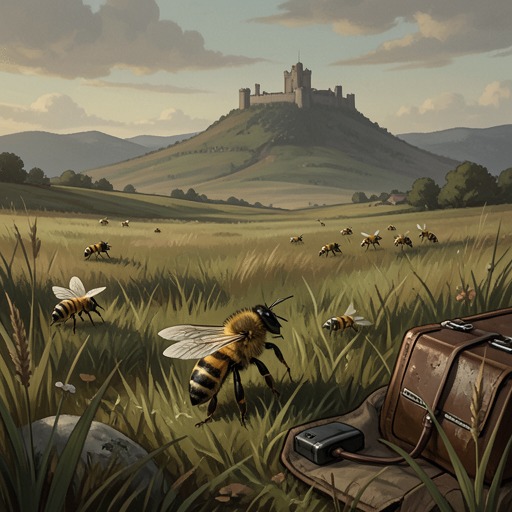
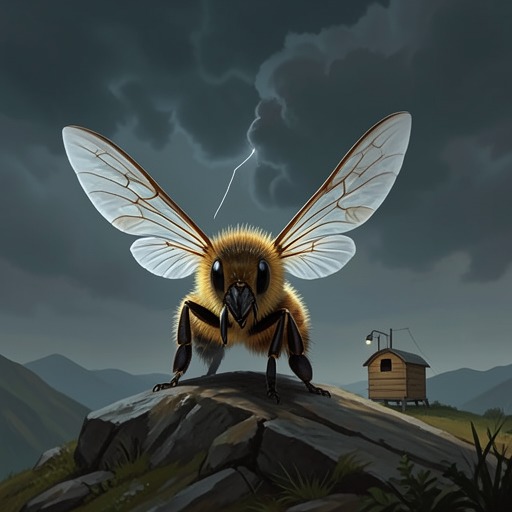
The fortress occupies an old nesting-box in the shrubbery near the trunk of a large willow. Thomas points out that the box is poorly placed for starlings: its entrance does not face the sunrise, a reason he doubts birds would choose to live there. The Hornets have instead entrenched themselves in it. Thomas describes it as the largest Hornet fortress in the country and warns Maya that Hornets lie in wait for Bees. From outside, Maya can see the fortress’s brown walls against the green, making the threat suddenly concrete rather than merely reported.
The Hornets’ construction differs from the Bees’ wax-built home. Their walls are made of a dry, porous, grey material resembling paper. That material establishes the fortress’s distinct appearance and, later, its vulnerability: the partition between Maya’s cell and the council hall is brittle enough for her to bite through. The walls therefore perform two opposing functions. They separate the captive from the assembled Hornets and conceal their deliberations, but they are not an impenetrable barrier.
A Place of Captivity and Surveillance
After a Hornet seizes Maya, she regains consciousness inside the fortress in a prison chamber. A narrow gap in the wall admits a little light, allowing her gradually to make out the room. Its floor bears the remains of insects killed there, including Bees; the evidence makes clear that Maya is being held in a place where captives face mortal danger. The cell is not simply a hiding place: it is part of the Hornets’ system of capture and confinement.
The gap also gives Maya a way to observe what happens beyond her cell. Through it she sees a large hall filled with Hornets, illuminated by captive glow-worms, with the Hornet queen presiding over a council. A guard moves along the walls, directing the glow-worms to provide more light while trying not to interrupt the meeting. The scene connects the fortress’s private spaces to its public center: Maya is imprisoned at the edge of the hall, close enough to witness the decisions that will determine the Bees’ immediate fate.
Council and the Planned Attack
At the council, the queen confirms an arrangement for the Hornet warriors to assemble one hour before dawn and attack Bee-city in the castle park. The orders specify that the hive is to be plundered and as many captives as possible taken. The Hornets are also promised a particular reward: whoever captures Queen Helen VIII and brings her back alive will be made a knight. The plan thus joins a military objective to a personal prize, revealing both the intended scale of the raid and the queen’s interest in seizing the Bees’ ruler.
Maya overhears the decision from her cell. The council’s words transform her knowledge of the fortress into urgent intelligence: the attack is scheduled for the following morning, and the hive is the target. Rather than remain where she has been placed, she waits until the guard’s footsteps have faded, enlarges the opening in the wall, and squeezes into the hall. She knows discovery would cost her life. From there she moves cautiously through the shadows toward the narrow passage and the distant entrance, using the fortress’s layout to seek a route out.
Escape and Strategic Significance
The fortress is dangerous not only because it houses the Hornet queen and her warriors, but because its walls contain Maya within reach of their plans. Yet the brittle partition gives her a narrow opportunity: by widening the chink, she passes from cell to hall and then makes her way toward the exit. The sequence makes the building’s physical arrangement part of the plot. The wall that had separated her from the council has also allowed her to listen, and its weakness converts that knowledge into a chance to act.
The planned assault places the fortress at the beginning of a larger conflict, while the Bee response supplies a contrast to Hornet power. As the Hornets approach the hive, the Bees mobilize rapidly and without disorder; soldiers take assigned positions, and wax-generators reinforce the entrance with two thick partitions that narrow it by almost half. In the ensuing battle, the Hornets’ physical strength and armor meet the Bees’ disciplined defense and superior numbers. An older Hornet later identifies the Bees’ unity and loyalty to their community as a decisive source of strength. The fortress therefore represents concentrated military threat, but not an assurance of victory: the plan formed within its walls encounters a collective resistance that its leaders have underestimated.